He stood in the wash of neon and let the market noise close back over him. Then he walked.
The industrial edge of the district had a different smell — solvents, ozone, the metallic patience of things waiting to be hauled away. He took it because the salvage was better and because no one out here cared what he was looking at.
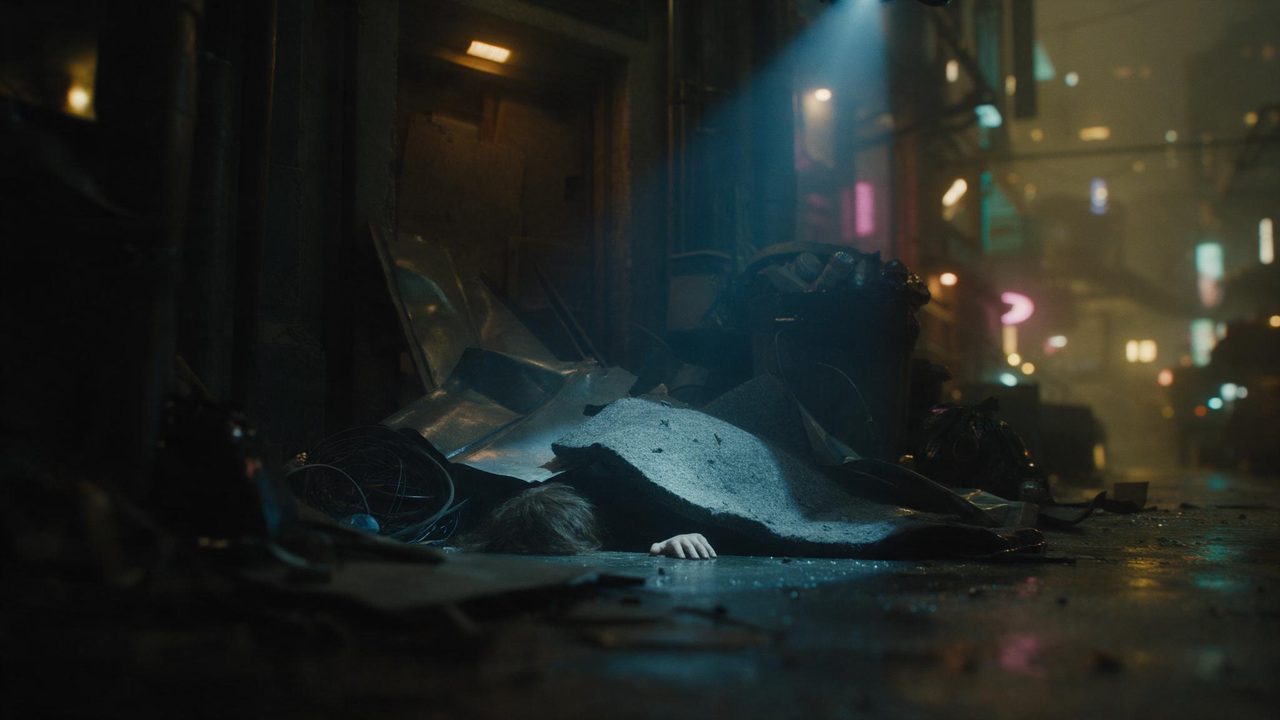
A heap of twisted plating caught the light near an overflowing recycling bin. He drifted closer for the metal and saw the hair first — a tuft of mousey brown, half-buried under a torn insulation mat in the recess of a boarded doorway.
He went still. Then he crouched and started clearing.
It was a synthetic. High-end. The dermis under his palm was silky, soft in the way good dermis was silky and soft — close to human, expensive close. Her dress had been blue once. Both legs were gone below the knee; the stumps showed actuator rod, severed conductive line, the dull gleam of carbon bone. Red fluid had pooled and tacked over against the concrete.
He didn’t recognize the face. Some lounge’s, probably. Some bad night’s.
“How’d you end up like this,” he said, quiet, because he talked to scrap when he was alone and this was scrap-shaped at the moment.
She didn’t answer. She wasn’t going to.
He sat back on his heels. A high-end companion model abandoned in an alley was a story with too many possible owners — lounges, fixers, scavenger crews with pry bars. None of them were people he wanted to meet over a body. If he left her, she was parts by morning. Stripped by somebody worse.
“All right,” he said.
He worked his arms under the torso, careful of the cut edges, and lifted. She was lighter than a person and heavier than her size suggested — reinforced bone, dense actuator mass. The stumps made the geometry wrong. He shifted her until she rode against his chest.
He pulled the EMI blanket out of his satchel one-handed and shook it over her head and shoulders. With his thumb he keyed on the cobbled scrambler in his hip pocket; it threw broadband noise across the bands the patrol drones liked. He slouched. Junk scavenger with a junk bundle. He had walked this posture a hundred times.
“Be junk for me,” he muttered. He kept his voice low.
The checkpoint was two drones doing lazy arcs at the end of a side street. He kept his pace ordinary. The nearer drone swung toward him as he passed under it. The hum of its scan climbed half a step, hung, and dropped. It turned away.
He let his breath out a block later.
It took him nearly an hour to arrive at his workshop, a repurposed industrial unit hidden at the end of a defunct access corridor. Over time he had made it more and more like a home, although to some it was never home enough. He bolted the door behind him, crossed the ad hoc kitchenette without turning the lights on, and took the stairs down. The yellow LEDs came up in their tired rows. Here, half-finished electronic projects, 3D printed objects, and salvaged circuit boards competed for space with makeshift shelving. He set her on the workbench, brought the brighter work lights down, and got his first clean look.
It was worse close up. Deep abrasions along the torso. Shredded actuators at the stumps. The legs hadn’t been cut — they’d been crushed and torn. He had seen industrial failures that took limbs cleaner than this. The face, though, looked almost peaceful.
He pulled the beacon scanner off the shelf and ran it over the chest. Blank. He shifted angles, ran it again. Nothing. Every commercial synth he had worked on pinged a model and a manufacturer the moment a scanner came within range; it was a hardware-level function, designed to survive damage.
“Whatever took her legs must have taken the transmitter too,” he reasoned aloud. He did that when he thought he was alone. April made fun of him for it when she was around. “Takes a lot to kill one.”
He set the scanner aside. Power first.
He absently patted his micro-solder gun. “All right,” he murmured again, speaking to the broken figure. “Let’s see if there’s enough left of you to power up safely.”
Julian cracked his knuckles out of habit, standing over the workbench where the battered synth now lay. Mousey brown hair framed her face in disarray, and through half-lowered lids he caught a glimpse of bright blue eyes that, even powered down, seemed to hint at a quiet watchfulness.